Pyrimidine pathway explorer (PYPE) is designed for a pan-cancer analysis of the association pattern between pyrimidine metabolism and signaling pathways or metabolic processes based on the pathway-based approach. The approach enables to study the regulatory processes behind pyrimidine metabolism in cancer.
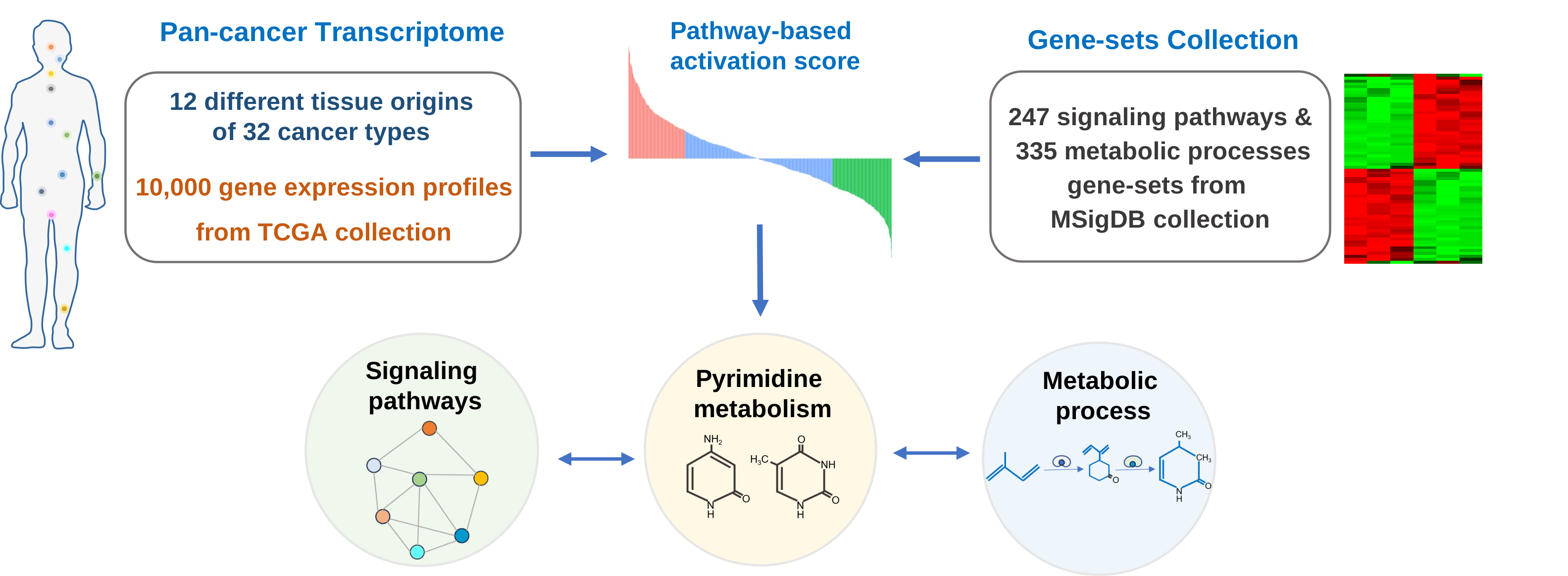
Signaling Pathways
Metabolic Processes
Custom Analysis
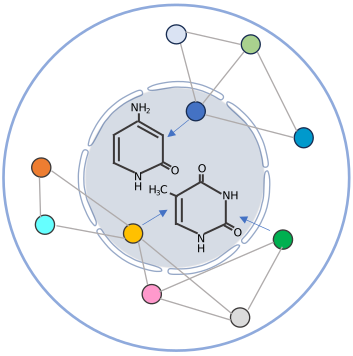
Investigate the association between pyrimidine metabolism and 247 signaling pathway gene-sets in individual or selected cancer types
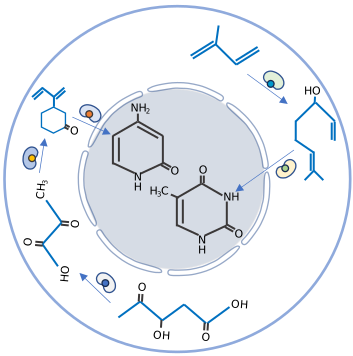
Investigate the association between pyrimidine metabolism and 335 metabolic process gene-sets in individual or selected cancer types
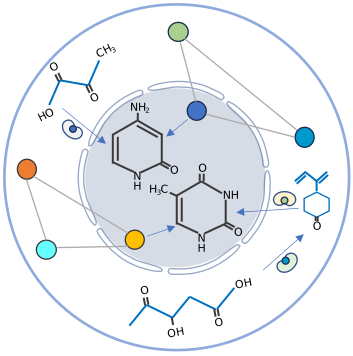
Investigate custom gene-set (signaling or metabolic process) association with pyrimidine metabolism in individual or selected cancer types
Loading...
Loading...
Loading...
Loading...
Summary
Deregulated signaling pathways and metabolic processes in cancer contribute to various hallmark features including uncontrolled proliferation, immune compromise, metastasis and chemoresistance. Uncontrolled cell proliferation often relies on the nucleotide metabolism (purines and pyrimidines) as a backbone feature in mediating the proliferative capacity of the cancer cells. And more specifically, pyrimidine metabolism has been shown to contribute to various cellular and molecular features of cancer from cancer initiation to epithelial-mesenchymal transition leading to the advanced stages including metastasis. Nevertheless, the role of intricate signaling pathways and metabolic processes regulating pyrimidine metabolism is still required to uncover the therapeutic potential for cancer treatment. We conducted a comprehensive pan-cancer oriented pathway-based analysis in around 10,000 gene expression profiles representing 32 cancer types of 12 different tissue origins. We enumerated the connectivity scores between pyrimidine metabolism and signaling pathways or metabolic processes across cancer types. The web portal, pyrimidine metabolic pathway explorer (PYPE), is a resource to the scientific community to explore the associations of novel gene-sets with pyrimidine metabolism and its associated signaling pathways and metabolic processes towards identifying novel molecular mechanism and exploit therapeutic drug targets.
Pathway-based activation analysis
Signaling pathways and metabolic processes activity scores were calculated using a z-score based methodology. Gene-sets representing several signaling pathways or transcription factors and metabolic processes were collected from MSigDb. Normalized gene expression profiles of TCGA 32 cancer types were obtained from cbioportal website. Where available multiple gene-sets were used to strengthen the correlation observations between pyrimidine metabolism and pathways. Users can also explore the associations either by selecting individual cancer types of interest or the entire 32 cancer types in the custom correlation analysis section wherein user-defined gene-sets (single or paired) can be pasted to analyze the associations with pyrimidine metabolism. Clinically acceptable correlation thresholds of r > +0.3 and r < -0.3 were set as in-built configurations for the results output with significance ideally set to <0.05. Adjusted p-value was calculated based on the gene-set permutation. A correlation plot depicting the associations between pyrimidine metabolism and pathways can be found in the result page. The web portal also provides a downloadable bar plot depicting the activation pattern of signaling pathways or metabolic processes for each cancer type. Choose gene of interest will allow one to know the presence of gene in which signaling or metabolic processes for further exploration in relation to pyrimidine associated pathways. Nominal thresholds of above +2 and below -2 were highlighted as high activation score (red) and low activation scores (green), respectively, across cancer types. However, the user can also download the activation scores of the samples to set a different threshold such as median to explore independently for any downstream analysis (For ex: prognosis). In case of multiple cancer type analysis, apart from the correlation values in each cancer type, a meta-correlation report will also be generated as an output. The analysis output also delivers an overlap analysis report on the commonality of genes between the gene-sets.
Data and code availability
The complete data of gene-sets collection, transcriptome profiles, pathway activation and correlation scores, and script describing the activation score calculations can be found here.
Contributors and Contact
Mert Demirdizen - mert.demirdizen@bilkent.edu.tr
Vignesh Ramesh - vramesh@bmb.sdu.dk
Thomas Koed Doktor - thomaskd@bmb.sdu.dk
Paolo Ceppi - pceppi@bmb.sdu.dk
For multiple cancer analysis, the website might take several minutes to generate the results. We are constantly working onto improve the analysis to generate faster output. If you have any issues with your analysis, feel free to contact us by email.
Reference
Please acknowledge PYPE in your publications by citing the reference below:
